
Electric Truck Axle Guide: How to Choose the Right E-Axle for Heavy-Duty Trucks?
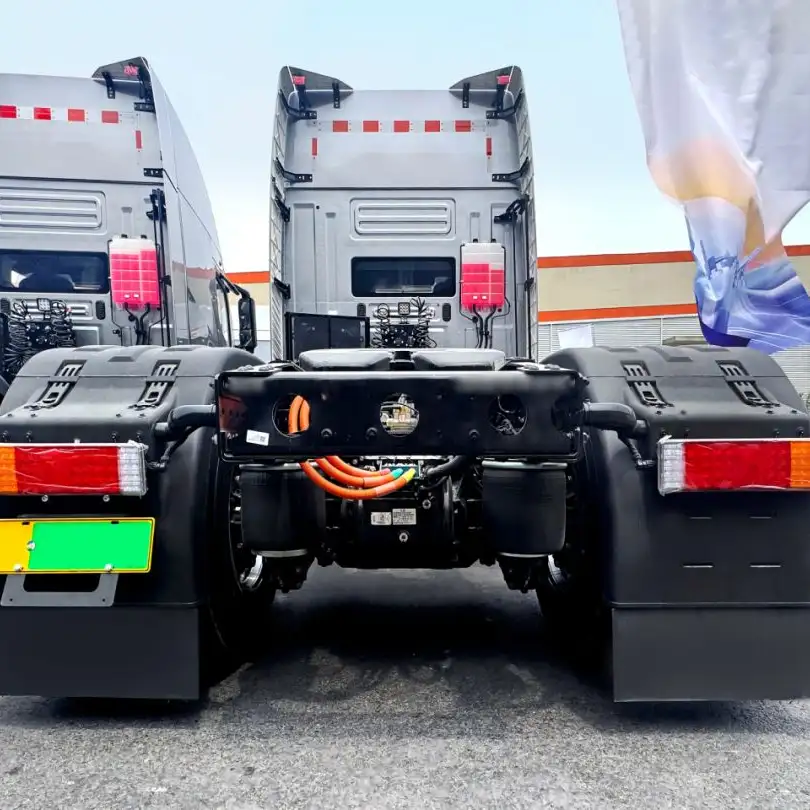
Electric Truck Axle Guide: How to Choose the Right E-Axle for Heavy-Duty Trucks? https://youtu.be/rakSt-jDAsQ?si=8im9tnZpT0SHnLz6 As electric heavy-duty trucks continue to gain market share, a clear understanding of key drivetrain systems—especially the electric truck axle—is becoming increasingly important for OEMs and commercial EV developers. What types of electric truck axles are available today, and what technical factors should be considered when selecting the right solution? In this article, we explore the core dimensions of electric truck axle selection, including structural layout, motor configuration, transmission stages, and PTO integration. This guide is designed to support engineering and product teams in making informed decisions when developing or sourcing electric heavy truck platforms. Brogen Electric Truck Axle on the Heavy-Duty Truck 1. The Structure of Electric Truck Axle Traditionally, a drive axle consists of four main subassemblies. Axle Housing: As the core load-bearing structure, the housing plays a critical role in supporting the entire axle system. Depending on the manufacturing process, axle housings can be categorized into three main types: Stamped and Welded Steel Plates: Known for their cost-effectiveness and relatively low weight, this method is commonly used in light-duty applications. Hydroformed Structures: This process enables superior lightweight performance, making it ideal for applications with strict weight constraints. Precision Cast Housings: These offer high structural strength and load-bearing capacity, which is essential for heavy-duty operations and demanding terrains. Final Drive (Main Reducer): It converts torque from the driveshaft into torque at the drive wheels. One of the key performance indicators of the final drive is the diameter of its ring gear – the larger the diameter, the greater the vehicle’s load capacity and wheel-end output torque. Additionally, the gear ratio of the final drive is a critical factor affecting the vehicle’s power delivery and energy efficiency. Inside the final drive, there is also a differential, which allows the left and right wheels to rotate at different speeds when the vehicle is running. Wheel End: This assembly connects directly to the tires and is responsible for high-speed rotation. In older designs, wheel ends required grease lubrication, which routine maintenance typically needed every 50,000 km. Today, most heavy-duty truck axles have adopted maintenance-free wheel ends, significantly reducing service requirements and improving uptime. Braking System: It typically comes in drum or disc configurations. Among drum brakes, there are two common types: S-cam brakes and wedge brakes. Thanks to their simpler structure, faster response, and better space efficiency (especially in tight chassis layouts), wedge-type drum brakes have become the preferred solution in modern heavy-duty trucks. The axle housing, wheel ends, and braking system of this electric drive axle are largely identical to those of a conventional diesel drive axle. From a structural standpoint, electric truck axles are fundamentally similar to traditional diesel axle systems. There are tow primary structural configurations commonly used in the industry: Configuration 1: Integrated Axle Housing Structure This design retains the conventional layout of the axle housing, wheel hubs, and braking system – essentially mirroring a traditional diesel drive axle. The only major difference is the addition of an electric motor and gearbox assembly, which is mounted at the front flange of the axle. The motor delivers torque, which is then stepped down and amplified by the gearbox before being transmitted to the axle to propel the vehicle forward or in reverse. Electric Truck Axle With Integrated Axle Housing The key advantage of this configuration lies in its simplicity. It leverages proven components from diesel truck platforms – including the axle housing, wheel ends, and braking system – which helps reduce development time and keeps costs relatively low. However, there are notable trade-offs. Due to space limitations, it’s difficult to integrate a multi-speed gearbox – typically restricted to two or three gears at most – and there’s usually no room for a PTO. Another major drawback is that the center of gravity of the entire e-axle assembly is offset from the axle line, which can lead to undesirable dynamic behaviors during rapid acceleration or braking. These include pitching motions such as axle lift (front-up) during acceleration and nosedive during deceleration. Configuration 2: Three-Piece Axle Housing Structure Electric Truck Axle With Three Piece Axle Housing Structure This design features square-section axle housings on both sides, with the electric motor and multi-speed gearbox mounted in the center. The three segments are connected via flanges and bolts. The main advantage of this architecture is its compact layout, which allows the gearbox to be designed with 3, 4, or even 6 speeds. This enables improved vehicle performance and energy efficiency, particularly under varying load and terrain conditions. The primary drawback is the increased overall weight due to the bolted flange connections between the three sections. However, the structural integrity of this design is not compromised – the axle can support up to 13 tons, making it fully suitable for heavy-duty applications. Electric Truck With Three-Piece Axle Housing eAxle From a cost perspective, Configuration 1 is more economical and is currently more common in the market. However, from a technological and performance standpoint, the three-piece structure – with its modular layout and support for multi-speed transmissions – is emerging as the mainstream trend in electric axle development for heavy-duty trucks. 2. Choosing the Number of Motors Due to space constraints, electric truck axles typically integrate a single motor. For example, our latest e-axle features a single motor delivering 300 kW peak power (407 hp) and 200 kW rated power (271 hp). It utilizes an oil-cooled system and achieves a maximum output torque of 38,483 Nm. With its integrated axle housing design, it supports a maximum axle load of up to 16,000 kg. Electric Water Truck With Brogen Single Motor Electric Truck Axle To further increase power output, dual-motor configurations are required. These can be arranged in two main ways: Inline configuration: Two motors positioned front and rear, jointly driving the central final drive. Distributed design: Similar to the layout in the Tesla Semi, where the second axle is used as the drive axle. It employs two motors, each driving one half-shaft independently,